
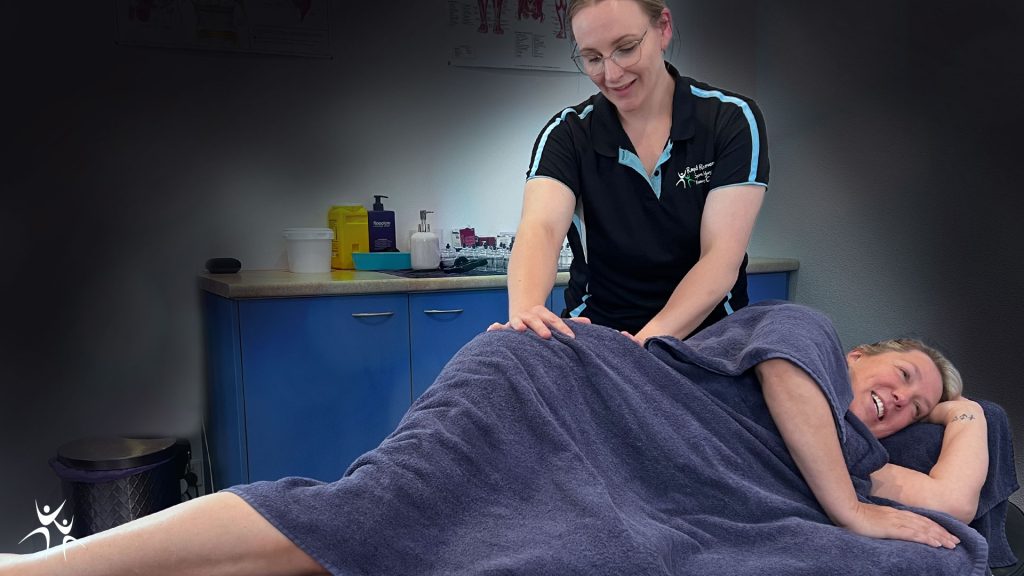
It hurts… but it feels good at the same time?
If you've ever had a massage or myotherapy treatment where you've thought: “This is going to sound weird, but it hurts… and somehow it feels good at the same time?”
Not weird. Literally how I make a living.
There is actually some interesting stuff happening within your nervous system that can help explain why a particular amount of pressure can sometimes feel uncomfortable and relieving at the same time.
One concept involved is diffuse noxious inhibitory control, or DNIC.
And yes, it sounds much more complicated than it needs to be.
So, what is DNIC?
In simple terms, your nervous system has mechanisms that can influence how strongly you experience pain when another strong but controlled sensation is introduced.
Think of it as your nervous system going: “Okay, I can feel that… but this other sensation is taking up a lot of my attention, so let's turn the volume down on that pain signal for a bit.”
This is one possible explanation for why some types of hands-on treatment can feel surprisingly good, even when the pressure itself is uncomfortable.
You might experience it as: “Ooooh, that's sore.”
Followed shortly by: “Ohhhh… that actually feels really good.”
And then: “Yep. That's the spot.”
We've all been there.
But there is a difference between ‘good pain’ and just… pain
This is where things get interesting.
More pressure does not automatically mean better treatment.
In fact, if you're lying on the treatment table holding your breath, clenching your jaw, gripping your fists and wondering whether you can survive the next 30 seconds…
That's probably not the sweet spot.
The goal isn't to see how much discomfort you can tolerate.
The goal is to find the right amount of sensation for you.
That might be quite firm for one person and surprisingly gentle for another. It can also change depending on:
- the area we're working on
- how your body is feeling that day
- whether you've had a chance to warm up
- your stress levels
- your previous experiences with pain
- how comfortable and safe you feel during treatment.
And sometimes, no pain at all is exactly what you need.
This is why treatment isn't just about finding the ‘tight spot’
When I'm working with someone, I'm constantly paying attention to how they are responding to treatment.
That means the things you tell me are important.
Is it:
- good pain?
- sharp?
- warm?
- stingy?
- pulling?
- uncomfortable?
- referring somewhere else?
I'm also watching for the things you might not say out loud.
Are you clenching?
Holding your breath?
Guarding the area?
Tensing up?
Trying very hard not to move?
All of that gives me useful information.
So I'll be asking questions like:
- Is the pressure helping?
- Does the sensation change when I alter the direction?
- Does it feel better after we've warmed the area up?
- Has your breathing changed?
- Are you able to relax into it?
- Does the discomfort settle, or is it getting worse?
- And perhaps most importantly: Does it actually feel useful to you?
Because your body isn't a map where I can simply find a certain muscle, press on it for 30 seconds and magically fix everything.
Unfortunately, my job doesn't come with a giant button labelled: “RELEASE TENSION HERE.”
It would be much easier if it did.
It's a bit of an art
Finding the right pressure, in the right direction, after the right amount of warm-up, in a calm and comfortable environment…
It's an art.
There is definitely science behind what we're doing, but there isn't a perfect pressure setting that works for everyone.
You have to work with the person in front of you.
Sometimes that's firmer pressure.
Sometimes it's lighter work.
Sometimes we need to spend more time warming an area up first.
Sometimes the thing that feels amazing one week feels completely wrong the next.
And that's okay.
Your body isn't exactly the same every day, so your treatment doesn't have to be either.
What if you've had a treatment that was too uncomfortable?
If you've ever walked away from a massage or myotherapy treatment thinking: “That was way too painful.”
Or perhaps the opposite: “That basically felt like a tickle and I don't think it did anything.”
You might have experienced treatment that simply wasn't finding the right level of input for you on that particular day.
That doesn't necessarily mean the therapist was doing something “wrong”.
Different people respond differently to pressure, and sometimes it takes a bit of experimenting to work out what feels appropriate and useful for you.
And if you've had a treatment that was too uncomfortable in the past, it's absolutely okay to say so.
You don't get bonus points for suffering through your treatment.
In fact, telling your myotherapist or massage therapist what you're experiencing can help them adjust the treatment to better suit you.
So… what does your ‘good pain’ feel like?
For some people, it's a strong pressure that feels like it gets into the area they need.
For others, it's more of a mild ache or stretching sensation.
For some people, pain isn't helpful at all.
And that's completely okay too.
There isn't one “correct” treatment sensation.
The goal is to find an approach that feels appropriate for your body, your nervous system and what we're trying to achieve together.
So next time you're lying on the treatment table thinking: “This hurts… but it feels good…”
You can know that your nervous system may be influencing how you're experiencing that sensation.
And if you're thinking: “This hurts and I absolutely hate it…”
Please tell me.
That's useful information too.